
What Does ChatGPT Say About Your Business? I Checked My Own Blog
I ran a free AI visibility check on my own blog. AI described it partly right and recommended it for none of three customer questions. Here's what it found and what I'm fixing first.
A lot of people now ask an AI assistant before they search. "Who's a good dentist near me." "Which tool should I use for this." "Is this company any good." The answer they get is built from whatever the web says about you, and most business owners have never looked at it. I ran a check on my own blog to see what it says, and the result was humbling enough that I want to walk you through it.
There are really two questions here. First, when someone asks about your business by name, does the AI describe you correctly? Second, when a customer asks for what you sell without naming you, do you come up at all? The second one is where the customers you don't have yet are.
Key takeaways
- AI assistants describe your business from what other sites say about you: directory profiles, old snippets, social pages. If those are out of date, the answer is too.
- Being described correctly and being recommended are different problems. You can get the first one right and still not appear for a single customer question.
- Most of the fixes are boring and cheap: one clear description everywhere, current pages, and a page that answers each question your customers ask.
- A new page won't show up the week you publish it. Linking to it from your older pages helps it get found.
- Treat any check as a snapshot. Assistants use different searches and their answers change over time.
How the check works
We built a free AI Visibility Check for this. You enter a business name and a website, and an AI assistant (Claude, by Anthropic) runs live web searches, the same way ChatGPT, Perplexity and Google's AI answers build theirs. It does two things:
- It asks what your business is, and compares that answer with what your own site says.
- It writes three questions a customer might ask without naming you, searches each one, and reports who shows up instead.
It's free and needs no signup. Each check runs real searches, so there's a limit of a few a day. One detail I care about: if a question didn't actually get searched during the check, the report says "Not checked" instead of telling you that you don't appear. A scary red result you didn't earn isn't useful to anyone.
What it said about my own blog
I ran it on LaconicML, a free machine learning blog I run, with tutorials going back to 2020. It took about a minute and looked at 12 pages.
The headline was "AI gets you partly right." The description was mostly fair: a free blog about machine learning, AI and data science, with short posts that usually include Python code. But the differences were the useful part:
- A directory profile describes something we don't do. The check found that LaconicML's Crunchbase profile describes courses and a platform for organizations. It's a free blog. It sells no courses.
- The author changed and nobody explained it. Profiles describe a tutorial blog with Python code. The newest posts are broader AI pieces published under the name "Publizo", the WordPress account Publizo publishes them with. To an AI reading the site, that looks like a different author with a different voice and topic.
- The homepage is stuck in 2019. The meta description and the dates search engines show are from 2019 and 2020, so the snippet AI tools see describes an older site.
- Contact details don't match. The check found one email on the site and a different one on Facebook. Small, but it's exactly the kind of inconsistency that makes a profile look less trustworthy.
None of this is dramatic. It's what happens to any site that has been around for a few years and was never cleaned up. That's the point: you wouldn't notice it unless you looked.
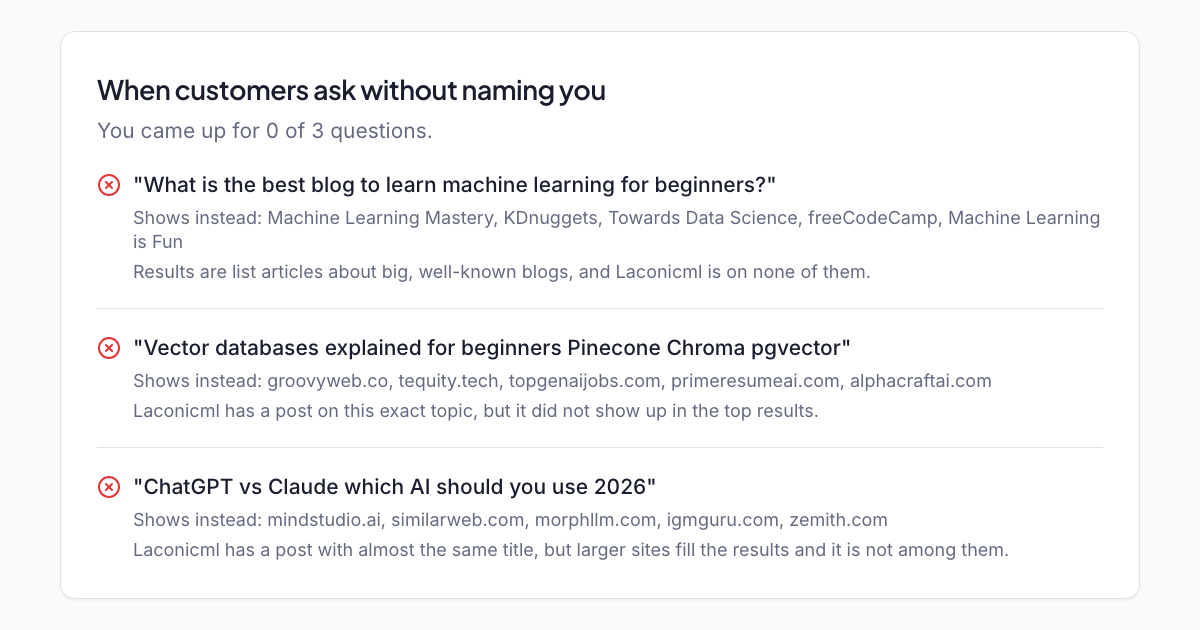
The part that stung: 0 of 3
Then the customer questions. These were the three it chose, and each one was searched in its own words, without my blog's name:
- "Where can I find free machine learning tutorials with Python code for beginners?" Class Central, Codebasics, Springboard, Machine Learning Plus and Kaggle came up. LaconicML didn't.
- "Vector databases explained for beginners: Pinecone vs Chroma vs pgvector." Five other sites came up. We have a post on exactly this topic, but it went up on November 16 and hadn't surfaced yet.
- "What are the best free courses from top universities to become a data scientist?" Harvard Online, KDnuggets, Open Culture and others came up. LaconicML has posts from 2020 on free Harvard and MIT courses, and none of them appeared.
So: zero for three, on a site that has written about all three topics. That's the gap between having content and having the page that answers the question today.
I ran the check again the next day. It picked three different questions, including "What is the best blog to learn machine learning for beginners?", and the result was the same: 0 of 3. That's the report at the top of this post.
Why AI gets a business wrong
An AI assistant doesn't know your business. It reads what's out there and repeats the most consistent version of it. If your directory profiles, old snippets and social pages say slightly different things, you get a blend of them. If an old profile says you sell courses, the AI may say you sell courses.
The same goes for being recommended. When someone asks a question, the assistant leans on pages that answer that question clearly, are current, and are linked to from elsewhere. A years-old post that touches the topic usually loses to a fresh page built around the exact question.
What I'm fixing first
The check ends with a short list of what to fix first. Here's mine, roughly in the order I'm doing it:
- One current guide instead of old fragments. A single "free data science courses from Harvard, MIT and Stanford" guide, refreshed for this year, with a clear list and a visible date. The 2020 posts get folded into it or point to it.
- Help the new post get found. Link the vector database post from the older machine learning posts, put a short plain answer at the top, and add a simple comparison table. The pages that did show up use tables.
- Fix the homepage description. One plain sentence about what the site is and who it's for, instead of a 2019 meta description.
- Make every profile say the same thing. One contact email everywhere, and the Crunchbase description corrected to "a free blog".
- Put a real person behind the posts. An About page with the real author, location and topics, and an author page that explains who writes the new posts. AI tools tend to trust a site more when it's clear who stands behind it.
None of these needs a developer or a budget. Most of them are an afternoon.
How to run it on your own business
- Open the AI Visibility Check and enter your business name and website.
- Read "What AI says" next to "What your site says". Every difference is a page or profile somewhere that needs updating.
- Look at the three customer questions. For each one you don't appear in, ask yourself: do I have a page that answers exactly this, clearly, and is it current?
- Start with the "What to fix first" list. It's ordered for a reason.
- Run it again in a few weeks. Fixes take time to be picked up, and answers change.
If you're signed in to Publizo, the same check is under Tools > AI visibility.
Where Publizo fits
Most of the fixes above are housekeeping you can do yourself. The one that takes real ongoing work is the last mile: a clear, current page for each question your customers ask. That's what Publizo does. It writes those pages for your site, researched, with sources linked, in your brand's voice, and publishes them to WordPress, Shopify, Ghost, Blogger or any site.
You can run the free check first, and if it shows the same kind of gaps mine did, try Publizo free for a week: three articles, written for your own site.
Frequently asked questions
Is this exactly what ChatGPT would say about my business?
No tool can promise that. The check uses Claude with live web search, which is how ChatGPT, Perplexity and Google's AI answers build their answers too, but each assistant uses its own search and wording, and answers change over time. Read it as a snapshot of what the web says about you.
Why would an AI describe my business wrongly?
Because it repeats what other sites say: directories, old profiles, reviews and articles. If those still describe an old service, an old address or a business with a similar name, the AI does too. Updating them and publishing clear pages on your own site fixes most of it.
How do I show up for more customer questions?
Have a page that answers each question your customers ask, clearly and with real detail, keep it current, and link to it from your other pages. Make sure your main directory listings describe you the same way your site does.
How often should I check?
After you make changes, give it a few weeks, then run it again. A new page or a corrected profile isn't picked up overnight.
Is the check free?
Yes, with no signup. Each check runs real web searches, so there's a limit of a few checks a day.
Publizo writes articles for your own site.
About what your business sells, in your voice, on your site as a draft or live. 3 full articles over 7 days, no card.
Start your free weekFounder of Publizo. Has run websites since 2016.