
How I Built Publizo Between Freelance Design Work and Tech Research Deadlines
The honest story behind Publizo. A freelance UX designer moonlighting as a tech researcher, a horoscope site that ate my weekends, and the small automation that quietly turned into a SaaS.

I never planned to build a SaaS. I work full time as a freelance UI/UX designer across a rotating set of client projects, and on top of that I do tech research for a YouTube channel with 2.6 million subscribers. Two very different jobs, both demanding. When my day is done, I still have a few personal sites I care about, and one of them, Luna Zodiac, was slowly eating every free hour I had. Publizo is what I built to get my life back, and it turned out other people wanted the same thing.
Why couldn't I keep up with my own blogs?
My freelance design work is deep, focused, and unpredictable. One week is user interviews and Figma, the next is a research sprint for the YouTube side. When I finish for the day, the last thing I want to do is open a blank WordPress editor and write another 1,800 word article about a news story that will be stale in 48 hours.
So my personal blogs died the slow death every side project dies. A post here, three months of silence, a burst of guilt, another post, more silence. I had topics I genuinely cared about and readers who kept coming back, and I still couldn't publish consistently. It wasn't a motivation problem. It was a time problem, and no productivity trick was going to fix eight extra hours a week that I simply did not have.
What broke me was daily horoscopes
Then I launched Luna Zodiac. The idea was simple. Real astrology content, updated daily, weekly, monthly, for every sign. I underestimated how much writing that actually is. Twelve daily horoscopes. Twelve weekly. Twelve monthly. Plus love, career, and money variants. Plus seasonal specials.
For the first month I did it all by hand. I would sit down on a Sunday and try to batch a week ahead, then miss a day, then scramble on Monday morning before a client call. The site was good. The workload was not sustainable. I was one bad week away from letting it die too.
The first automation was tiny
I started small. One script that took a rough outline and turned it into a full daily horoscope in my voice. Nothing fancy. It saved me maybe twenty minutes a day. Then I added a second script for weekly posts. Then one that handled the featured image. Then one that pushed everything to WordPress as a draft so I could review before it went live.
Two months in, I looked at what I had built and realised I was no longer writing horoscopes. I was reviewing them. My weekends came back. Luna Zodiac was posting more consistently than it ever had, and the traffic was climbing.
When did it become a product?
The moment it clicked was when a friend who runs a small news site asked how I was publishing so often. I showed him the setup, half apologising for how hacky it was. He said something like "if this existed as a tool, I would pay for it tomorrow."
I thought about that for a week. Every solo publisher, indie blogger, and small media site I knew was fighting the same problem. Great topics, no time. The tools that already existed either produced obvious AI slop that Google was starting to punish, or they were built for agencies with big budgets and complicated workflows. There was nothing in the middle for the person who just wanted their site to keep breathing.
Building Publizo out in the open
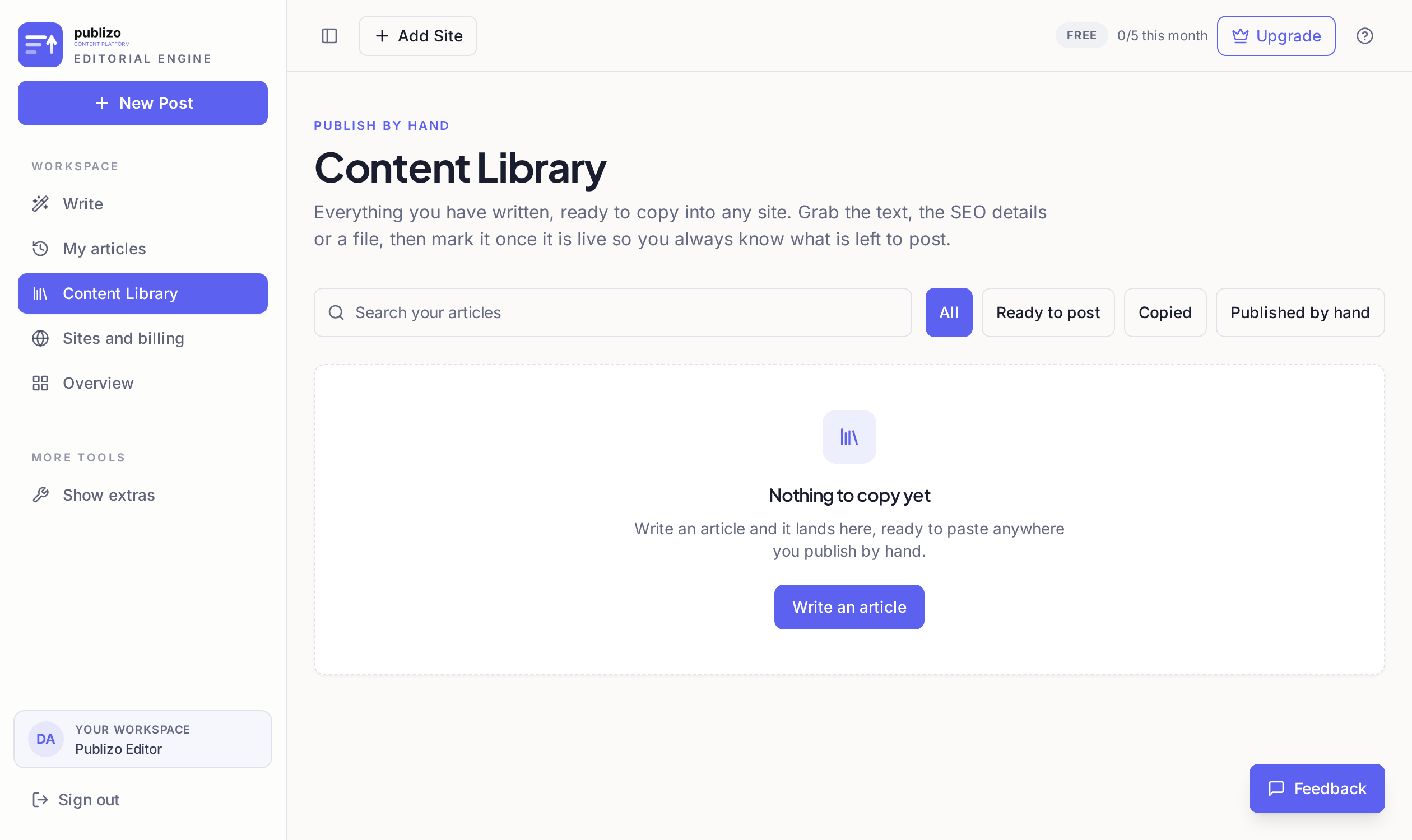
I took what I had built for myself and started rebuilding it as a real product. Cleaner code. Real accounts. A dashboard instead of a folder of scripts. WordPress publishing that respected the way people actually work, meaning a draft you review, or live when you choose it, and none of the "surprise, I posted twelve articles to your live site" horror stories you hear about with other tools.
I added the SEO modes I was already using myself, Rank Math and Yoast targets, structured data, meta descriptions that were not just the first sentence of the article. I built in the constraints I had learned the hard way from Google's helpful content updates. No AI tells. No em dashes everywhere. No obvious three item lists in every paragraph. No invented experience.
What I got wrong at first
Plenty. Early versions tried to be too clever and produced articles that were technically fine but sounded like every other AI tool. I ripped out the fancy prompt scaffolding and rewrote the whole generation pipeline around one rule. If a human expert would not write that sentence, the tool should not write it either.
I also underestimated how much the boring parts mattered. Uploading featured images with the right alt text. Setting the correct post status. Handling WordPress sites that had weird permalink structures. Half of Publizo is now those unglamorous details, and that is what makes it actually usable instead of a demo.
Who is it for?
Honestly, people like me. Solo publishers who care about their sites but do not have eight free hours a week to keep them alive. Niche site owners who want to publish daily without hiring writers. Small teams who need a real editorial workflow, not a magic button that posts garbage.
It is not for content farms. The daily limit for each site and the checks before publishing make that painful on purpose. If you want to spray 500 word thin articles across a hundred sites, there are other tools for that, and Google will find you eventually.
Where it goes from here
I still use Publizo every day for my own sites. Luna Zodiac runs on it. My other blogs run on it. That is the honest test I trust more than any metric. If I would not use it, I would not ship it.
The roadmap is shaped by what I hit in my own publishing week. Better source ingestion. Smarter internal linking. Cleaner handling of affiliate content for the people who asked for it. Not because a spreadsheet said so, but because I ran into the same limits and wanted them fixed.
If any of this sounds like your week too, you can write 3 full articles over 7 days for free, with no card. Try it on your own site and see.
Publizo writes articles for your own site.
About what your business sells, in your voice, on your site as a draft or live. 3 full articles over 7 days, no card.
Start your free weekFounder of Publizo. Has run websites since 2016.